Trends, propaganda, and banker wars

Trends, propaganda, and banker wars
If you trade forex...consider this!!! Click on Banner
Showing posts with label currency. Show all posts

Monday, May 17, 2010

Geography of the Euro


The year is 1999 and the European Union or EU has been growing in members since the 1940's.


In 1945 WWII ends and six countries; Belgium, France, the Netherlands, Italy, Germany, and Luxembourg, got together to set up a union between neighbours with the intent of lessening the potential for future war. The aim is to unite sovereign neighbours under a European flag which would lead to greater economic and political order.


In 1957 the EEC or European Economic Community is founded by the Treaty of Rome. The EEC becomes the "common market".


In the 1960's the founding countries of the EU trade against each other without charging custom fees. The food and agriculture sector of the young EU is merged and food production goes into a surplus even after the collective population is fed.


In 1973 the EU membership is increased to nine countries after the UK, Ireland, and Denmark sign on. In 1981 Greece is included in the EU as the tenth member. In 1986 Spain and Portugal join and within a year the Single European Act is signed which pursues rules of a "single market" with the free flow of trade across EU borders.


The four freedoms of a single EU market are promoted as the freedom to move people, money, goods, and services across EU borders.


In 1995 Austria, Finland, and Sweden join the EU and the collective Europa now numbers 15 countries.


More treaties are signed including the 1993 Maastricht Treaty, the 1999 Treaty of Amsterdam.


In January of 1999 the Euro is introduced as the new currency of the land or Europa or as it is better known the EU or European Union.


Meanwhile the EU membership numbers as kept rising and 27 countries belong to the unconstitutionalized land of Europa.


The Euro currency is legal tender in many countries but not all EU countries have implemented the new legal tender of the EU as their official currency of trade. For example the UK continues to trade the Great Britain pound. Meanwhile Montenegro, the Vatican City, and other countries trade in Euro but do do not fully belong to the Eurozone.


Eurozone trade or trade conducted by those countries who have changed to the Euro is regulated by the EMU or Economic and Monetary Union. The Euro is monetary policy is set by the European Central Bank.


In 1999 the Euro started trading at about 111 USD but by 2001 the Euro had lost nearly 30 percent of it's value. The New York Tower issue of 2001 sends investors panicking and looking to the Euro as a safe haven. For several months the momentum behind the Euro continues and the EurUsd currency ends up trading in a range between 118 and 130 for months. This is less than 10 percent above the price where the Euro started trading in 1999. It bounced to 137 around the time of Katrina in Louisiana and then lost value to the 118 level until 2006 when the Euro took off for a new high which settled in 2008 at about 160 EURUSD.
From that high the Euro lost all of the gains and returned to settle at the mid 118 - 137 level before the US bank fiasco in America. This initialized a new wave towards the Euro which did not surpass the 160 level. Somehow the money markets or the people who move financial instruments around were not ready to promote the Euro as the reserve currency of the world any longer. Ireland banks were defaulting and Greece was near backruptcy so the story goes and the Euro took a dive starting in January of 2010. The Euro knife looks like it might find support at 118 to 116 but any news out of Euro of defaults or even rumours of war amongst neighbours could have the Euro tumble to par or even lower within a few months.
Some financiers and financial advisors talk of the Eurozone going the way of the DoDo bird.
That seems like pure bogus. The Euro and the Eurozone will remain players in the global foreign exchange markets for years to come we say. What is happening today is part of a bigger program where par EURUSD is only one act.
What is interesting here is that once the EURUSD settles and bounces, and it will, then it will also take the EURGBP upwards towards par.
Another act in the plot is a par EURGBP.
One world currency is on it's way and the Geography of the Euro is just an act in the program.

Sunday, May 16, 2010

Canadian pounds...Canadian dollars.


The Canadian dollar was once a Canadian pound.


This is logical since Canada is a commonwealth country. This Commonwealth association remains active with 54 countries having historical links to the United Kingdom continuing to participate in this intergovernmental organization. Every couple of years the heads of government meet and represent the interests of nearly 30 percent of the world population. Australia is part of the new Commonwealth organization and will host the next meeting in 2011.


Canada becomes a Confederation in 1867 when the province of British North America (Canada), joined itself to the Atlantic colonies of Nova Scotia and New Brunswick. This was a declaration signed by Queen Elizabeth as the British North American Act. In passing time other colonies joined in as provincial territories federally responsible to the sovereign flag of Canada. In 1949, Newfoundland was the last to join.


In 1841, the Province of Canada ( Quebec and Ontario ), was trading Canadian pounds similar to the Sterling pounds of the UK. The years that followed was a time to consider which way to go with the Canadian currency. It was a choice between staying with the sterling silver UK system or opting instead for an Americanized decimal currency system.


In 1853 a gold standard was introduced in the Province of Canada and pegged the Canadian currency to a basket which included only the British gold sovereign and the American gold eagle coins.


A few years later the British gold sovereign continued to be accepted for trade but the Canadian currency had moved to a decimal system pegged to the US gold coin.


Paper money had been issued for years already and circulated in several denominations. The first bank to issue bank notes was the Bank of Montreal in 1817.


In 1870 Canada is a country and refers to itself as the Dominion of Canada. The banknotes ( paper money ) issued by the Dominion range in denominations from 0.25 to 50 thousand $. The shinplaster or quarter note was discontinued in the early 1900's.


By 1935 the Dominion of Canada notes are all replaced by paper currencies legislated by bankers and financial governors answering to the Bank of Canada. Canada was not yet complete and those areas not yet signed on had their reserves and their own issues.


At this stage Canadian pounds are Canadian dollars and they are legal tender.


In 1944 the Bretton Woods Agreement was signed and brought about a new gold standard by which most currencies were pegged. The Bretton Wood system stayed active until 1971. However there were periods when the Canadian dollar was allowed to float and find it's value according to speculator sentiment. From 1950 to 1962 the CAD traded nearly par with it's American counterpart. In the sixties the CAD returned to the gold standard peg of the Bretton Wood system. From 1970 to 1974 it was floating again and money market speculators moved it from its peg value of 92.5 cents to $1.0443.


Snowbirds were happy and flocking to the southern states for cheap vacations in the sun.


However the CAD started to tank, and tank, and tank, all the way to 0.70USD by 1985.


The Canadian dollar is considered a commodity currency and while it is a major currency that ranks 6 to 8 in its power of providing liquidity to the foreign currency exchange markets it is highly regulated by the price of oil and minerals and grains. The oil embargos of 1973-1974 caused panic in commodity markets.


There was some recovery towards par for the USDCAD from 1986 to 1991 but again the oil world fell into panic with the wars in the Middle East deserts and the gains towards dollar par fell to new lows by 2001.


If volatility is not a risk factor for you then consider that since then the oil quotes have moved oil futures contracts from 35 dollars to 150 dollars US and back to 50 and back to nearly 90. All the while the Canadian pounds turned Canadian dollars have swung with the commodity sentiment, or as others might put it...........commodity quote manipulation!!!!


That's the humble Canadian pounds turned Canadian dollars in a nutshell.


Par She Blows....Like a gusher......

Saturday, May 15, 2010

new zealand dollar.

New Zealand is found some 2000 kms from Australia. It's capital city is Wellington and it trade money internationally as the NZD or the New Zealand dollar. There is a population of about 4 million people of which about 15 percent are of Maori descent and indigenous to the Polynesian pacific islands.

The people of New Zealand are largely agriculturalists farmers and sheeps outnumber humans at 13 to 1 odds. Much of the immigration community comes from Europe or the Netherlands. Like the Australian, the New Zealanders were using a pound along with shillings and the pence for trading purposes until the mid 1960's. Like the Australians they followed a financial system pegged close to the Great Britain Sterling pound until the Bretton Woods Agreement of 1944 came into effect and opened a new gold standard where the US dollar was the reserve currency of the world.

The British influence began in 1840 with the arrival of Naval Commander William Hobson who brought with him British coinage of gold, silver, and bronze. Hobson settled new colonies in the Polynesian Pacific and they became legal tender by 1858. When coins became scarce money printers attempted to print paper notes but met little success. Copper coins or tokens seemed to fair better as a currency and were implemented. These were minted not only by the Brits but also by locals. This practice was outlawed by the turn of the century and only British coins could be considered legal tender. They were traded with mostly Australian precious metal coinage.

By 1914 minted gold was being removed from circulation and silver coins were being minted with less purity.

In 1933 when Roosevelt is signing the Emergency Bank Act in the US the financiers in New Zealand are considering adopting a system of decimalization.

By 1935 New Zealand was administering its own currency coins which remained in the form of pounds. They were the last commonwealth to become self governing.

In 1947 nickel based coins replaced silver based coins.

By 1963 the decimalization of currency coins was finally approved and the decimal currency act of 1964 set the rules by which these coins would be minted and distributed.

In 1967 the New Zealand paper dollar as we know it today under the nickname of kiwi was introduced. The NZD or NZ$ was first pegged to the US dollar at a value of USDNZD = 1.39:1. Within a year the rate was devalued and reset at 1.12 to 1.

Other revaluation set the peg at different levels until 1985 when the New Zealand dollar was allowed to float openly on the foreign exchange markets where it became subject to the sentiments of buyers and sellers of currency. The initial offering of the floating NZD was 0.4444 US dollars.

Whether or not the New Zealand dollar can be considered a major currency is debatable. It is the 12th most liquid currency globally.

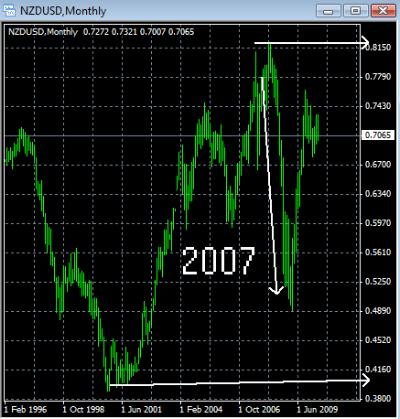
The Central Bank of New Zealand saw a problem with what they perceived to be an overly strong NZD in 2007 when it was trading at over 0.80 US and intervened by printing large volumes in order to drive down the value of the NZ$. However in the few years since the NZD value has almost fully recovered. The paper dollar along with the decimalization coins introduced in 1967 are how trades and financial transactions are completed in New Zealand.


Owning New Zealand dollars is still very risky since they are such a small nation with little influence on the global economy. This is why we ask if they are truly a major currency.

The intent of this blog is to show how major currency parity across the board could present an opportunity to return to a gold standard and another scenario similar to that discussed in Great Gold Robbery. Is the New Zealand dollar part of this hypothesis. We will know eventually.

From pound to dollar


The year is 1966 and the Australian paper currency is shifting from pound to dollar.


Robert Menzies is the Australian Prime Minister in 1966. Before his office, the Commonwealth of Australia, traded an Australian Pound. This pound was pegged to the Sterling pound UK and reflected the common ties between the British nation and the Australian Commonwealth until 1946 when the Aussies opted to peg the Australian pound to the US dollar. In 1944 the Bretton Woods Agreement had renegotiated the terms of a gold standard and the US dollar was the currency of choice for reserve banks internationally.


One pound did not have decimals until 1966. With the move from pound to dollar the Aussie currency now followed a decimalized system where one dollar was 100 cents and initially cash transactions were carried out to the nearest penny. This changed in recent years where the nearest nickle is considered standard.


Bretton Woods fell apart in 1971 and the Australian Dollar began to trade on par with the US dollar. In 1974 the Australian financial administration opted for a basket of currencies to peg the AUD to.


AUD is the ISO or currency code of the Australian dollar.


The basket had the intention of acting as a trade weight index and the move towards this system of accounting was in part supposed to reduce the volatile fluctuation experienced by being solely pegged to the US currency.


In 1983 the AUD was released from the peg system and the TWI and allowed to float freely. This meant that the currency of the Australians was being valued by free markets and the sentiment of currency traders.


It has remained a floating currency and one of the major currencies of the world and at this time is amongst the top ten highest traded currencies on the foreign exchange. The Australian dollar is considered a commodity currency since it shifts in price with the movement of metals, mostly gold which is a rich resource in the Commonwealth of Australia.


However such is not always the case as the current market turbulence ( May 2010 ) indicates.


The conditions in Europe are seeing lots of forex money move towards the US dollar. The price of gold is hitting new highs at 1250 US dollars yet the AUDUSD pair is moving in favor of the USD. This is a slight anomoly.


The move from pound to dollar was made in 1966. Several names were courted for the new paper fiat of Australia. Amongst the suggestions were Austral, Kaola, or Royal.


However the Australian went for dollar. The AUD is nicknamed the Aussie or sometimes the Pacific Peso and provides about 5 percent of the liquidity on the foreign exchange interbank system.


A chart of the Australian dollar trading the USD to 2010.


Volatility is tradeable but not for the greedy or those who do not understand the power of using (h)edging instruments.


What is a Gold Standard ?


"We have gold because we cannot trust governments". Herbert Hoover


By the same reasoning governments can also force people to rid themselves of their gold and give them paper money or another currency in exchange. This happened in the US with the Emergency Banking Act of 1933 when Roosevelt was looking to edge the country by stabilizing the banking industry.


What is a gold standard ?


Paper money is so well accepted as an exchange medium that few people consider what a paper dollar is. It's a contract. It is a means of trading one good or service at a price today and holding the paper dollar contract for a period until another trade is to be implemented. The value of that paper dollar is worth more or less in the future. That is true in a free market where the paper dollar is not pegged to the price of an underlying commodity such as gold.


When a countries currency is pegged to a standard it continues to fluctuate in value but only to the extent of the underlyings value. When a gold standard is adopted by a country then that countries currency is worth as much as gold.


Paper money is fiat. It is worth nothing but the ink and paper that are used to make it or it is worth has much as the underlying financial asset which it is pegged to. If it is backed by nothing then it has no underlying fundamental value. In such a case the price of a fiat is based on the investors trust that the paper money will continue to be used in the future and that someone will trust that it is tradeable for a value that is close in price to what it was acquired at.


But paper money tends to make people nervous and when people lose confidence in a fiat they dump it like there was no tomorrow. The worst case scenario for a fiat is a period of hyper inflation as was seen in Germany in the early 1900's. Consider that within a year a person was paying the price of a house for a piece of bread and you begin to understand the weakness of fiat.


Back when England was the superpower and the British pound was the main currency of the world, paper money became a major problem. This had to do with creating debt with fiat as the underlying saviour. By 1821 England responded by imposing a gold standard. For some time all trades were carried out under the gold standard. Stockpiling gold became a means of measuring wealth and massive amounts of gold was mined and stocked in vaults for future use.


In 1871 Germany followed suit and soon most nations were playing the trading game by the rules of a gold standard. The US lagged in their decision to join the movement towards a gold standard. They were the last major country to play along.


In 1821 the Industrial Revolution was in it's infancy. Steam engines and iron led the way for railroads, automobiles, and airplanes. Factories were the new way of mass producing goods that were shipped worldwide and traded at a standard gold quote.


1914 comes along and the world is in mass disagreement. Americas role in the industrial revolution has made them rich and powerful and they have become as great an influence on world economic balance as their former overlords from the old World. The first world war breaks out and the gold standard contract is also about to be broken.


Countries of the world look to the US and England for financial security and the fiat of both these nations becomes the reserve currencies of the world. Buying currency with gold means that the US and the Brit gold vaults are getting fat, as are those of other leading nations, including France. Most smaller countries give up their gold for paper currency.


War is costly however. England pays a great price and lose much of their wealth. The US dollar eventually remains the only reserve currency.


In 1918 the first world war ends and people think that no war could ever be so atrocious. There is a global sentiment that the worst is behind them and the 1920's is a period of high rolling and high risk, over leveraged speculation. It is a period where people overdose on buying debt.


1929 comes along and a sudden shock of reality instills itself in the minds of those gamblers who are holding debt held on an underlying paper currency. Suddenly everyone is rushing to trade their paper money for gold bullion as they watch the stock markets plunge into the abyss.


England uses its gold reserves to pay off war debts leaving the US and France as major gold holding countries.


In 1931 England breaks away from the gold standard.


1933 comes along and the Roosevelt administration forces the gold out of their pockets by enforcing a new legislation where gold is to be converted to paper money. This is a rule and not a request.


In 1934 Gold in the US is revalued to 35 dollars and ounce from 20.67 which means that the American citizen who was given fiat for their gold, and who looked to buy new gold would have taken a nearly 2 to 1 depreciation on their trade.


In 1939 the US had a lock on gold reserves. They held a vast majority of the gold supply already mined and enough gold to back the printing of untold volumes of fiat which was being bought by global players of the economic game. In 1939 Hitler was forming his Aryan nation on the presumption that he would lead the Germans away from a system of hyper inflation which they'd witnessed when the Deutsch Mark was rendered worthless. Amongst his many promises he convinced his followers that they would move towards a Utopian society.


But the world would have no such thing.


The second world war ended in 1945 after the US joined the Brits and Churchill. As it was ending the international bankers were signing on to the Bretton Woods Agreement which was a new gold standard where the American dollar was sold on the gold reserves held in the American vaults.


However by the mid 1960's much of the gold from the US pegged at 35 dollars an ounce was being challenged by international gold which was being traded on a fluctuating or floating price market. The debt bought on paper currency ( US dollars ) was no longer finding a fair underlying value and the American Bretton Woods gold standard was being revamped.


In 1971 central banks worldwide were no longer seeking gold as an underlying commodity to appraise the value of fiat paper money.


The gold standard was no more.


What is a major currency ?

About parity and gold is about major currencies all trading at par.

What is a major currency ?

A major currency is the paper money unit of a country or group of countries which is highly traded on the foreign exchange markets. There are several such currencies. The four most prevalent ones are the US Dollar (USD), the Eurozone Dollar (EUR), the Japanese Yen (JPY), and the Great Britain Pound (GBP), the Canadian Dollar (CAD), the Australian Dollar (AUD), the Swiss Franc (CHF), and even the NZD or New Zealand Dollar.

When traded against one another they form pairs. For example EURUSD is a code for the Euro trading against the US dollar.

The three letter code is an ISO standard. Any major currency can be traded against another major currency and these trades are carried out under a pair code such as EURUSD is the Euro trading against the US dollar.

The highest volume of trade as of late as been on the EURUSD. These trades are carried out on an interbank network in the foreign exchange market or forex.

The Yuan is the Chinese currency but unlike the list above this countries money is closely pegged to the USD. It does not float freely on the open markets and is not reliably tradeable to retail fx traders.

Along with the major currencies there are hundreds of minor currencies which form pairs but they are not highly liquid and can move dramatically in hours and then not at all for days or weeks.

The Australian dollar, the Canadian dollar, and the New Zealand dollar, are considered to be commodity pairs and usually can be closely correlated to the movement of metal prices or oil contracts.

The USD has been the reserve currency of the world since it took over this role from the Great Britain Pound in the first part of the 1900's. In 2008 when the US banks went bust it seemed that the EUR was going to become the next reserve currency.

A mere two years later in 2010 the Euro is being devalued and looking to go par with the USD.

There you have it for "what is a major currency?".

About Parity Money and Gold

Parity Money and Gold is a blog which concerns itself with the volatility of financial markets and the rush on gold.

More than that it is a blog which is meant to show a possible scenario of how things might be in the near future.

Gold was once used as a standard. It such times gold was the monetary system and the economic unit of account in trade. In such times paper currency is set to fluctuate near the price of gold. In such times central banks keep their countries paper currency worth near the price of gold.

This is called pegged to a standard where the standard is gold.

Today there are 6 major currencies in the world and they are free floating and the price of any of these currencies is set by the market. The market is the foreign exchange market and the major currencies are priced by auction. Many minor currencies are also priced by auction however the price of a minor currency does not weigh much on the social balance of the world.

Major currencies trade against each other and "About Parity Money and Gold" is an attempt to show a not so bright future for currencies where every major currency trades at par and where gold price first skyrockets, becomes a standard, and then tanks to extreme lows leaving the fiat nearly worthless.

Join us by linking to us and follow the financial charts we provide to see if you agree.

Who knows you may even be able to find a reason to trade currencies while coming to understand what moves global economies.

Search This Blog

Followers